Best Building and Upgrade Order: A Complete Strategy Guide
At a glance
Compare an upgrade’s price with the production it adds. Bulk buying is convenient, but it is not automatically the best value. Keep enough currency for the next useful upgrade.
Continue playing · How to Play RobuxClicker — A Complete Beginner's Guide · Prestige and the Beanstalk Tree — RobuxClicker Guide
Implementation checked on 8 September 2026 by the RobuxClicker project maintenance workflow.Every Robux you earn in RobuxClicker eventually goes back into the shop, and where you spend it decides how fast your income grows. This guide is about spending order: how the building cost curve works, which of the twelve buildings to buy next, and how to get the most out of all seventy-four upgrades. Nothing here is a rule the game forces on you — it is the strategy that turns a slow trickle of Robux into an avalanche.
How the building cost curve works
Buildings are the helpers that earn Robux for you while you do nothing. Each one has two numbers that matter: a base price (what the first copy costs) and a base Robux per second, or RPS (what one copy produces). If you are new to the term RPS, the complete beginner's guide explains it from scratch.
The catch is that buildings do not stay the same price. Every copy you buy of a building costs 15% more than the copy before it. In game terms, the price of the next copy is the base price multiplied by 1.15 raised to the number you already own. That 15% step is small at first and brutal later — once you have a stack of one building, the price of the next copy has run far away from the base:
- Once you own 10 copies, the next one costs about 4 times the base price.
- Once you own 25 copies, the next one costs about 33 times the base price.
- Once you own 50 copies, the next one costs over 1,000 times the base price.
- Once you own 100 copies, the next one costs more than a million times the base price.
Production, however, does not climb — each copy of a building always produces the same flat RPS. So within a single building you hit diminishing returns: the 40th Roblox Avatar earns exactly as much as the 1st, but costs vastly more. This is the central tension of the whole game, and it is why "buy order" is a real decision and not just "buy whatever is on screen".
One practical note before the strategy: the shop has buy-amount buttons — x1, x10, x100, and max. Buying x10 or x100 is convenient, but because of the 15% step it spends far more than ten or a hundred times the first price. Use the bigger amounts when a building is cheap relative to your income, and drop back to x1 when every purchase counts.
The twelve buildings at a glance
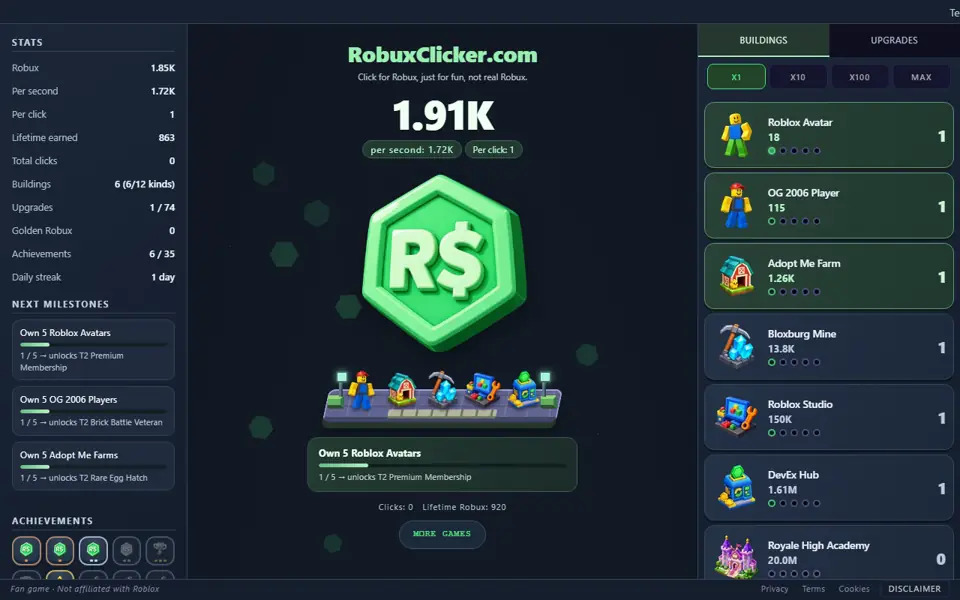
RobuxClicker has twelve buildings, listed in the shop from cheapest to most expensive. Here is every one with its base price and the RPS a single copy produces:
- Roblox Avatar — 15 Robux, 0.1 RPS.
- OG 2006 Player — 100 Robux, 1 RPS.
- Adopt Me Farm — 1,100 Robux, 8 RPS.
- Bloxburg Mine — 12,000 Robux, 47 RPS.
- Roblox Studio — 130,000 Robux, 260 RPS.
- DevEx Hub — 1.4 million Robux, 1,400 RPS.
- Royale High Academy — 20 million Robux, 7,800 RPS.
- Wacky Wizards Lab — 330 million Robux, 44,000 RPS.
- Brookhaven Mail — 5.1 billion Robux, 260,000 RPS.
- Murder Mystery Trade Hub — 75 billion Robux, 1.6 million RPS.
- Doors Hotel — 1 trillion Robux, 10 million RPS.
- Time Trials Speedrun — 14 trillion Robux, 65 million RPS.
Look at the value, not just the size. Measured on the first copy alone, the OG 2006 Player is the most cost-efficient building in the game — one full Robux per second for every 100 Robux spent. The Adopt Me Farm and the Roblox Avatar are close behind. From the Bloxburg Mine onward, each building converts Robux into raw production a little less efficiently than the one before it. The Time Trials Speedrun produces an enormous 65 million RPS per copy, but per Robux spent it is the weakest building in the game.
That does not mean you should ignore the expensive buildings. They exist for two reasons: their raw RPS numbers are so large that they carry your income in the late game, and — just as importantly — every building you unlock opens its own line of upgrades, which are where the real value lives. More on that below.
Which building should you buy next?
There is no single forced answer, but there is a heuristic that works well from the first minute to the prestige threshold. At any moment, the strongest purchase is usually the one that adds the most RPS for the Robux it costs right now — and because of the 15% step, that target keeps moving.
A simple, reliable routine:
- Unlock the newest building you can afford. The first time a building comes into reach, buy one copy. It is a milestone, it adds a chunk of RPS, and — crucially — it unlocks that building's five-tier upgrade track.
- Then deepen the buildings that are cheap for you. Spend leftover Robux topping up the buildings whose next copy is still cheap relative to your income. Early buildings stay affordable far longer, so they are easy bulk value.
- Keep a spread. Do not pour everything into x100 of one building. A balanced set of buildings means more upgrade tracks unlocking and more total RPS than one over-stuffed building ever gives you.
The shop helps you read this at a glance. Buildings you can afford are drawn with a green border and green cost text; buildings far out of reach are dimmed. If a building is glowing green and its next copy is cheap compared with what you earn in a few seconds, it is almost always a fine buy. Hover any building — even a locked one — to see its exact price and production in a tooltip.
Building upgrades: the best Robux you will spend
The shop's second tab holds the 60 building upgrades — five for each of the twelve buildings. Every single one does the same thing: it doubles the entire production of one building. Not one copy of it — all of them, forever, for one flat price.
That makes building upgrades the most important purchases in the game, but only at the right time. Each of a building's five upgrades is locked until you own a threshold number of that building. The five thresholds are fixed: 1, 5, 25, 50, and 100 copies. So a building's tier-1 upgrade appears the moment you own your first copy, tier-2 at five copies, and so on up to tier-5 at one hundred.
Here is the timing insight. A doubling is worth more the more copies you own, because it doubles a bigger pile of RPS. An upgrade that becomes available at the 25-copy mark is doubling twenty-five copies' worth of output for its flat price — far better value than the same upgrade would have been at one copy. So the rule of thumb is simple: whenever a building crosses a tier threshold, check its newly-unlocked upgrade and buy it as soon as you can comfortably afford it. It is rarely the wrong call.
The early tiers are cheap enough to be near-instant buys. The Roblox Avatar's five upgrades, for example, cost 100, 500, 50,000, 1 million, and 120 million Robux. The first two should go straight into your cart the moment they unlock. The late tiers on the expensive buildings run into the hundreds of quintillions of Robux and are genuine end-game goals — but they each still simply double that building, which by then is producing a colossal share of your income.
Click upgrades: ten doublings for hands-on players
The third group is the 10 click upgrades. Each one doubles your click power — the Robux a single manual click is worth. Click power starts at exactly 1, so buying all ten doublings raises a base click to 1,024 Robux before any other bonus.
Click upgrades unlock differently from building upgrades. Building upgrades watch how many copies you own; click upgrades watch your lifetime earned Robux. The ten thresholds start very low and climb steeply: the first click upgrade appears once you have earned just 50 Robux total, the second at 1,000, the third at 100,000, and each later one roughly a hundredfold beyond the last. Their prices climb the same way — 100 Robux for the first, 5,000 for the second, 500,000 for the third, and onward.
Are they worth it? Early on, absolutely — while you are still clicking by hand, doubling click power for 100 Robux is excellent value, and the cheap click upgrades pay for themselves in seconds. Later, your buildings produce so much RPS that a hand click is a rounding error by comparison, and click upgrades become a lower priority than building upgrades. They never become useless, though, because of the fourth group below. (There is also a fun achievement, "Pure Clicker", for earning a million Robux with no click upgrades bought at all, if you want a self-imposed challenge.)
Synergy upgrades: making every click scale
The last family is small but clever: 4 synergy upgrades. Instead of doubling a fixed number, each one adds a percentage of your total RPS to every click. They stack, and they are what keep clicking relevant deep into the game.
- Premium Crystals — adds 1% of your RPS to each click. Costs 10 million Robux; unlocks at 1 million lifetime earned.
- Robux Magnet — adds another 1% of RPS per click. Costs 1 billion Robux; unlocks at 100 million lifetime earned.
- Brainrot Resonance — adds 2% of RPS per click. Costs 1 trillion Robux; unlocks at 100 billion lifetime earned.
- Gamepass of Greed — adds 5% of RPS per click. Costs 1 quadrillion Robux; unlocks at 100 trillion lifetime earned.
Owning all four means every click is worth your normal click power plus 9% of your entire Robux-per-second total. Once your RPS is measured in millions or billions, that 9% turns a single click into a serious payout — which is why an active player should always pick up synergy upgrades as soon as they unlock. They are the bridge that stops clicking from ever becoming pointless.
A spending priority you can follow
Putting it all together, here is a priority order that works for most players, early game to late:
- Buy buildings as they unlock. Each new building is a milestone and opens a new upgrade track.
- Grab cheap building upgrades the instant they appear. Tier-1 and tier-2 upgrades on any building you own are some of the best value in the game.
- Pick up the early click upgrades while you are still clicking by hand — they are cheap and pay back fast.
- In the mid game, prioritise building upgrades for the buildings you own the most of. A doubling on a building you own 25 or 50 of is a huge jump in income.
- Buy every synergy upgrade as it unlocks. They are cheap relative to the lasting value of scaling clicks with RPS.
- Keep deepening a balanced spread of buildings so more tier thresholds — and therefore more upgrades — keep unlocking.
- Late game, chase the tier-4 and tier-5 building upgrades on your highest-count buildings. These are your biggest single income jumps on the road to the 1 trillion prestige threshold.
Common mistakes to avoid
A few habits quietly slow players down:
- Hoarding Robux. Robux sitting in your balance earns nothing. Idle income only grows when it is invested in buildings and upgrades. Spend it.
- Over-stacking one building with x100 buys. The 15% step makes the 80th and 90th copy of a building painfully expensive for the same flat RPS. Spread your spending instead.
- Skipping building upgrades to save for the next building. A 100-Robux doubling is almost always better than 100 Robux of raw new building. Do not walk past cheap upgrades.
- Ignoring the upgrades tab entirely. Some players only ever look at buildings. The 60 building upgrades are where most of your real growth comes from — check that tab often.
- Forgetting golden Robux. Buying order is only half the game; the power-ups from golden Robux multiply whatever you have built. The golden Robux and idle strategy guide covers them.
Where to go next
A smart buying order is the engine of a RobuxClicker run, and it pairs naturally with the rest of the RobuxClicker guides library. If any term here was new, start with the complete beginner's guide. Once your income is humming and you are closing in on a trillion lifetime Robux, the prestige and Beanstalk Tree guide shows you how to convert a finished run into permanent power. And to squeeze more out of every minute, the golden Robux and idle strategy guide is the natural companion to this one.